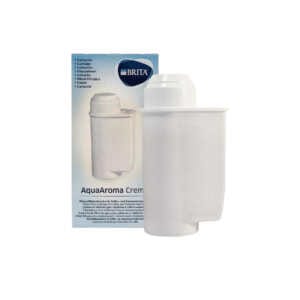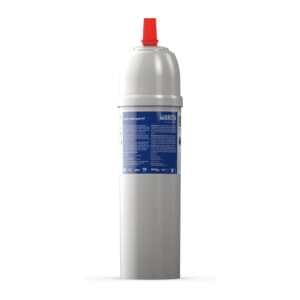
Water filters for espresso machines and coffee makers
Brita water filters for coffee machines
The Brita adventure began in 1966, under a pear tree in the family garden in Taunusstein (near Wiesbaden, Hesse), Germany. Heinz Hankammer, a former Pez candy salesman, stumbled upon a new water distillation that significantly simplified the process used by gas stations to producedistilled water for car batteries. He sensed an opportunity, founded his company with its first product—theAquaDeMat —and named it after his daughter: Brita. The first filters were assembled by hand, as a family, in the garden.
In 1969, while on his honeymoon in Tenerife with his wife Monika, Heinz Hankammer had a life-changing idea: what if we filtered tap water right at home, when making coffee? A year later, in 1970, Brita launched the world's first home water filter jug —a patented combination of ion-exchange resin and activated carbon. The jug removed chlorine, reduced limescale, retained certain heavy metals (lead, copper)—and radically improved the taste of both water and coffee.
Since then, Brita has become one of the world's leading consumer water filtration companies —claiming just over 80% of the market —with distribution in 69 countries, a turnover of €664 million in 2022, and more than 2,200 employees spread across Germany, the UK, Italy, and China. In 1999, Markus Hankammer —son of the founder—took over the company. His father, Heinz Hankammer, transformed his Taunus estate into a luxury hotelbefore his death. For its 60th anniversary in 2026, Brita is reinventing itself as a multi-solution, sustainable filtration : jugs, lead-lined filter tables, coffee machine cartridges, and professional HoReCa taps. At Cafemalin, we distribute the range of filters for espresso machines and coffee makers.
What has defined Brita since 1966: 4 pillars of expertise that explain its status as the world's No. 1 in consumer water filtration.
Brita's signature technology since 1970: a patented combination of ion-exchange resin (reducing limescale and heavy metals) and activated carbon (eliminating chlorine, chloramines, and unpleasant tastes). The result: softer water, without a chlorine taste, ideal for making coffee.
A Brita filter installed on the water line of an espresso machine or filter coffee maker drastically reduces limescale buildup—the main cause of premature failure in coffee machines. The result: less descaling required, extended machine lifespan, and better pressure and flow rate maintenance.
Brita is one of the world's leading manufacturers of consumer water filtration products, and claims just over 80% of the market share. Distributed in 69 countries, with a turnover of €664 million (2022) and over 2,200 employees. Production facilities in Germany, the United Kingdom, Italy, and China.
Brita remains a family business : Heinz Hankammer (founder) led the company until 1999, when he handed the reins to his son Markus Hankammer (current CEO). The name "Brita" is that of Heinz Hankammer's daughter—a unique fact in the B2C industry.
Brita's most ordered products by our customers — filters and cartridges for espresso machines.
Brita was founded in 1966 in Taunusstein (Hesse, Germany) by Heinz Hankammer. Their first product—theAquaDeMat —was a distilled water filter for car batteries, assembled by hand in the family garden. In 1970, Brita launched the world's first home water filter jug, an invention that would revolutionize consumer water filtration.
The brand celebrates its 60th anniversary in 2026 and remains a German family business — Markus Hankammer, son of the founder, is the current CEO.
Three main reasons:
It's a worthwhile investment: a few euros a month to maintain a machine that costs several hundred euros.
The choice of Brita filter depends on:
Consult the product sheet for each filter at Cafemalin to check compatibility with your machine, or contact our customer service team for personalized advice (response within 12 hours).
The replacement frequency depends on 3 factors :
In practice: 1 to 3 months for typical home use. Many modern espresso machines have an automatic filter change indicator —very handy. If yours doesn't, mark the replacement date on the cartridge with a marker.
Yes. Brita offers a complete range for Ho.Re.Ca. and professional machines:
The Brita professional range is distributed primarily through professional machine installers (Nuova Simonelli, Faema, Bezzera, La Marzocco after-sales service, etc.). At Cafemalin, our selection is mainly geared towards home and small office espresso machines.
No — this is an important clarification. Brita filters do not replace municipal drinking water treatment. They improve tap water (which is already safe to drink) on specific parameters:
For espresso coffee, Brita filtration is more than sufficient : it removes chlorine (which spoils the taste) and reduces limescale (which damages the machine). This is exactly the use for which it is optimized.
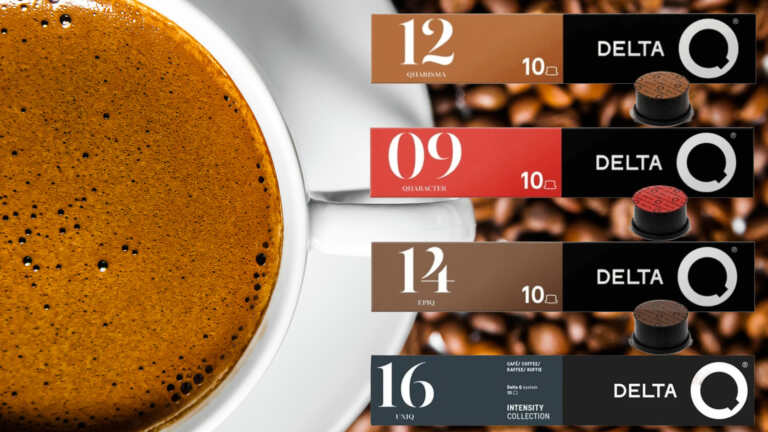 Buying Guide:Which Delta Q capsule should you choose based on your desired intensity? Qharacter 9 / Qharisma 12 / Epiq 14 / UniQ 16.
 Limited-time offer for back to school 2026: Enjoy 10% off everything Cafemalin
 Covim Granbar or Orocrema: Which Lavazza Firma compatible capsule should you choose?
 Lavazza Crema e Aroma Expert vs Crema Classica: which coffee beans to choose?